
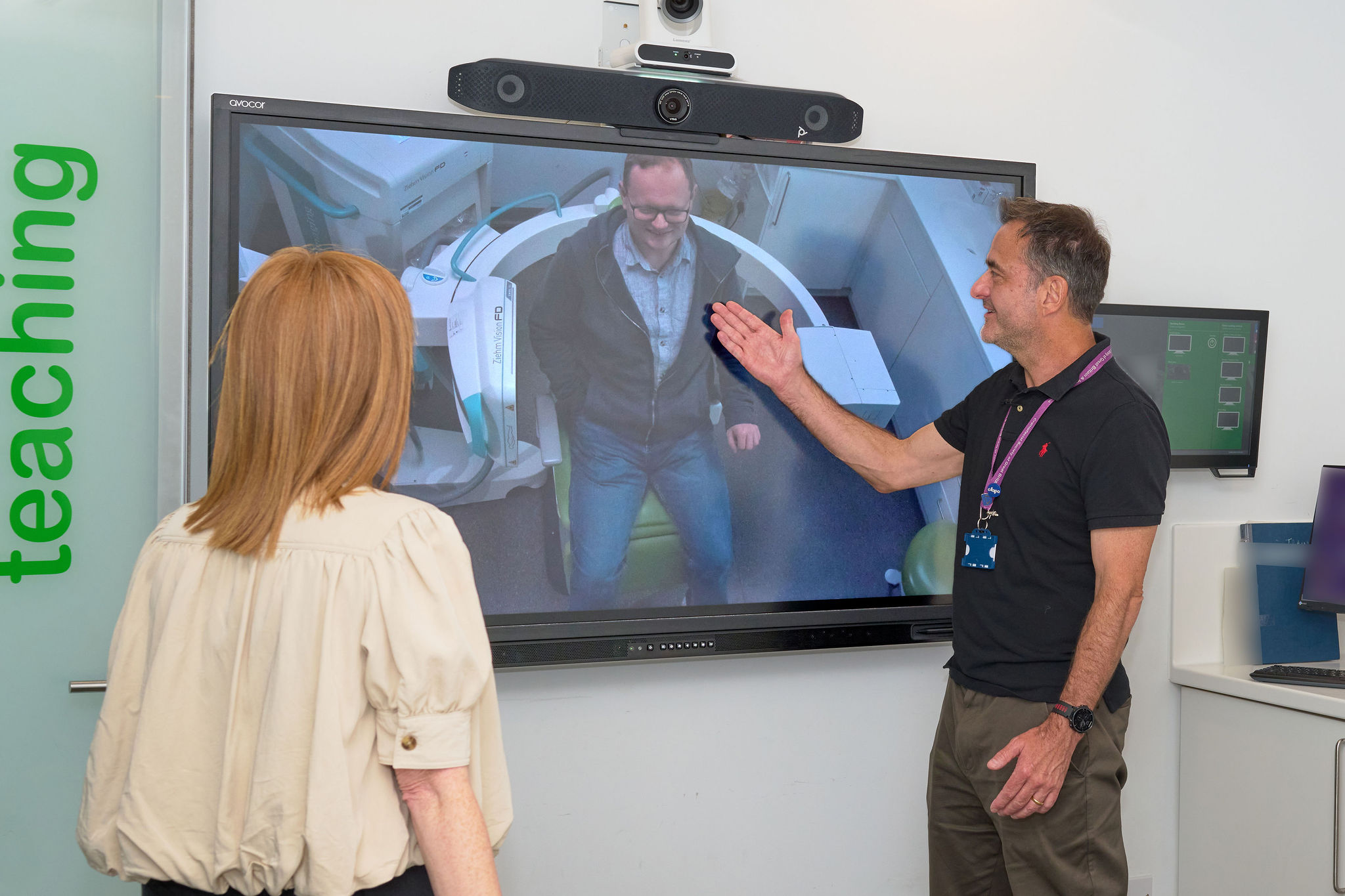
Members of CLAPA’s management team recently sat in on a cleft clinic hosted by the South West Cleft Service – and tested out their new hi-tech speech investigation assessment suite.
Ali Cobb, NHS South West Cleft Service Clinical Director and Consultant Surgeon, invited CLAPA’s Chief Executive, Claire Cunniffe, and Policy and Campaigns Manager, Lachlan Bruce, to attend the clinic at Bristol Dental Hospital.
It was led by Ali and fellow Consultant Surgeon, Shaheel Chummun.
We felt really privileged to be there.
Claire smiled: “Ali and Shaheel are brilliant, and so keen to share their work with us. It was a busy clinic day, nonstop from the second we got there, and we met many patients, clinicians, and staff. 
“Despite being busy, in all the appointments I sensed people had the time they needed. It never felt rushed, and was very much led on what people wanted to talk about and how they were feeling.
“We felt really privileged to be there. I’ve sat in on a clinic once before, many years ago, and this was Lachlan’s first.”
Claire and Lachlan joined Shaheel’s clinic, around a long oval table with Shaheel, clinical psychologist Dr Josie Steel, speech and language therapist Jo Waldron, and Vicky Carter cleft clinical nurse specialist.
She added: “We sat in on three different appointments, including a teenager, and his mum, who was considering orthognathic surgery to realign his jaw. The boy also wanted to talk about nose and lip aesthetics, and a possible rhinoplasty.
“Shaheel asked if he had a phone and took photos of the boy’s nose at different angles – so while they were having the conversation, they were looking at the photos on the boy’s own phone, instead of pointing at his nose. I thought that was a great, simple device to use.”
I was quite taken aback by how mature he seemed, and the way he talked with the surgeon about his appearance in such a matter-of-fact way.
Claire said Shaheel explained the surgery chronology to the teenager, and stressed recovery times, including numbness and breathing challenges. 
“The boy was undecided, and there was no pressure on him to make any decisions,” she added.
“I was quite taken aback by how mature he seemed, and the way he talked with the surgeon about his appearance in such a matter-of-fact way. I was sat there thinking, ‘I’d be uncomfortable talking to somebody about my face in this way, even at my age, never mind as a teenager’.”
Claire talked to the teenager about CLAPA’s peer support service and other support we offer – including speaking to somebody who’s had the surgery, or someone who had the option but decided not to go ahead.
Following the surgeon’s consultation, patients speak privately to a clinical psychologist, to check all’s okay. The psychologist meeting usually includes information on CLAPA’s resources.
After sitting in on the appointments, Claire and Lachlan were invited to try out the new state-of-the-art Vidiview speech investigation suite, recently installed at the clinic. 
Speech therapists Miriam and Jo explained how the appointments start with speech therapy clinical assessments. The imaging investigation centres on sitting in the chair (which Lachlan tried out!) whilst video x-ray capture is used to visualise the oral anatomy in speech.
Ali explained: “Camera views in the nose (nas-endoscopy) are sometimes used too and all the images are combined to make one final video showing all views at the same time.
“It’s linked to a screen in another room, where parents can watch their child having the video x-ray (videofluorsocopy), and the child can see them on a monitor attached to the chair.”
The new system allows the patients’ speech therapists to dial in from around the region and actively join the consultation conversation, seeing the imaging in real time. The imaging can be rewound and replayed immediately in the clinic, helping service users understand the options and plans for further care.
It’s a brilliant system and we were honoured to be shown it.
Claire added: “It’s a brilliant system and we were honoured to be shown it. It’s also great that if a child’s a little nervous they can talk to their parents throughout on the two-way monitors. Apparently, children get really excited because they get to see their parents on TV.” 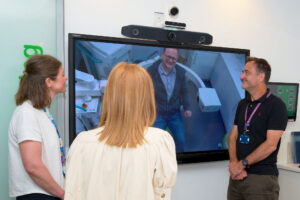
Claire said the clinic visit was invaluable and has led her to start to put in place a system to allow every staff member at CLAPA to have the opportunity to sit in on a clinic, to give them first hand understanding of the reality of cleft clinics.
“Everyone was very welcoming, and it felt very much like we were a part of the team. The clinics do a brilliant job telling people about CLAPA, and I think further visits from our staff members will help develop our learning too.”