
Antenatal Support Groups
CLAPA’s regular Antenatal Support Group events welcome both new and expectant parents to help you create a support network, ask questions and share your concerns. You are not alone.
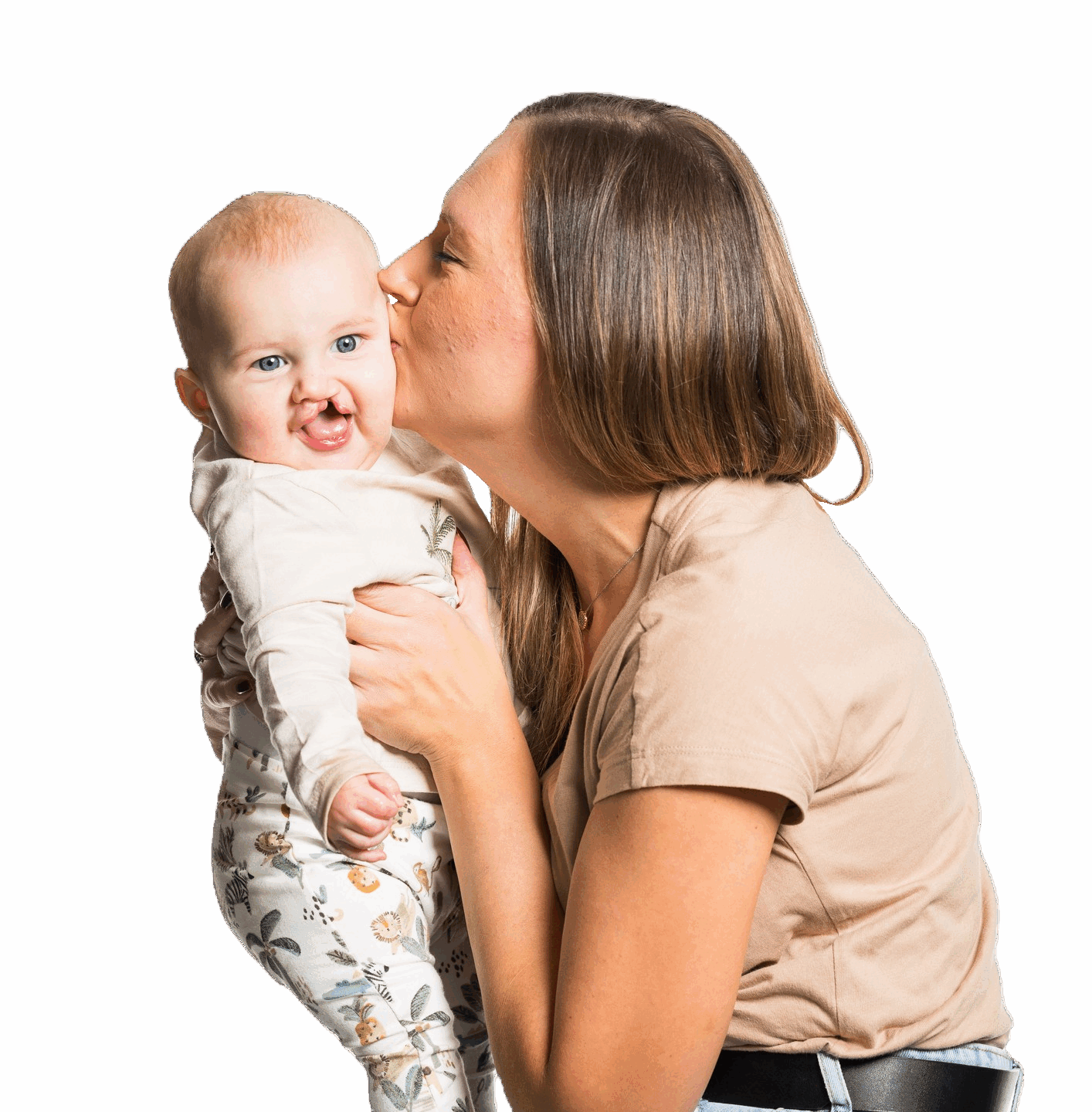
Find information and support if you've had a diagnosis of cleft after your baby has been born
Having a baby with a cleft can come as a shock, especially if there’s no known family history.
You’ve come to the right place – CLAPA is here to support you and your family from diagnosis right through to when your baby grows up and has questions of their own.
Top tip: There is a lot of information to take in on these pages. You don’t need to rush to read everything – it’ll still be here waiting for you when you need it. Try to be kind to yourself and look after your own mental health and wellbeing.
In early pregnancy, different parts of a baby’s face develop separately and then join together in the middle. If some parts do not join all the way, there is a gap or ‘cleft’.
A cleft lip is one or two gaps in the upper lip. It can range from a little notch in the coloured part of the lip to a complete separation of the upper lip which can extend up and into the nose.
A cleft palate is a gap in the roof of the mouth. This can range from a small gap at the back of the mouth to a gap that extends all the way forward through the gums.
A baby can be born with a cleft lip, a cleft palate, or both together.

Theo (6) was born with a cleft lip and palate
We don’t fully understand what causes cleft lip and palate.
There are lots of different factors which we think play a part, including both genetic and environmental influences.
It is very unlikely that your baby’s cleft was caused by something you did or didn’t do.
Your NHS Cleft Team may offer genetic testing which will help you to understand what caused your child’s cleft and the chances of it happening again.
With the right treatment and support, babies born with a cleft can grow up to be just as happy and healthy as any other child.
There are specialist Cleft Teams in the NHS to look after your child throughout their life. They will have regular check-ups and treatment as needed until they are an adult, at which point they can decide to go back for more treatment at any time.
CLAPA is here to support you, your baby and your family throughout your entire cleft journey.
The treatment your baby will need depends on the kind of cleft they were born with.
Your baby will need at least one operation to close their cleft. This will be done by specialist cleft surgeons in the NHS.
As your baby grows up, they might need further treatment such as hearing aids or grommets, speech therapy, and operations to help with speech, teeth placement, and other concerns. This will depend on the kind of cleft they have and how it affects them.
Your baby might have been diagnosed with cleft lip, cleft palate, or cleft lip and palate together.
While most cleft lips are diagnosed before birth at a routine ultrasound scan (around 75-80%), this doesn’t always happen. This could be because of the position your baby was in during your scans or the shape and size of their cleft lip.
It is extremely difficult to diagnose a cleft palate before a baby is born. This is because the gap is inside their mouth, so it’s very hard to see on a routine ultrasound scan. Shortly after birth, your midwife or another health professional should examine your baby’s mouth by gently pressing down on their tongue and looking at their palate with a torch. The RCPCH have guidelines on diagnosing a cleft palate.
An explanation of other medical terms can be found below.
A cleft palate should ideally be diagnosed within 24 hours of birth, although NHS guidance allows up to 72 hours. Unfortunately, in some cases, it can take weeks, months or even years before a cleft palate is diagnosed by health professionals.
This is more likely if it is a ‘submucous’ cleft palate, which is where there is a gap in the muscles in the roof of the mouth, but it’s covered by the lining of the mouth (see below).
Video: Mandy’s Story: Mandy’s son was diagnosed with a cleft palate when he was five years old. In this video, she discusses the signs which were missed by multiple health professionals, and her experiences of the treatment pathway with an older child.
CRANE Database: CRANE collects statistics on cleft lip and palate in the UK. They report on the timing of cleft diagnosis using the following categories: during pregnancy, within 24 hours, within 72 hours, within 1 week, within 1 month, up to 6 months, and more than 6 months.
A cleft lip is one or two gaps in your baby’s top lip.
A cleft palate is a gap in the roof of your baby’s mouth.
In cleft terms, ‘isolated’ means either a cleft lip or a cleft palate, not both together.
An ‘isolated cleft lip’ means one or two gaps in the upper lip without any gaps in the palate.
An ‘isolated cleft palate’ means a gap in the roof of the mouth without any gaps in the upper lip.
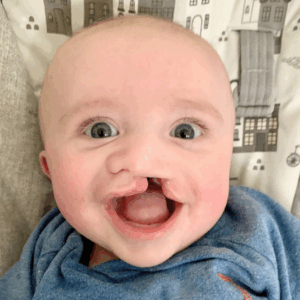
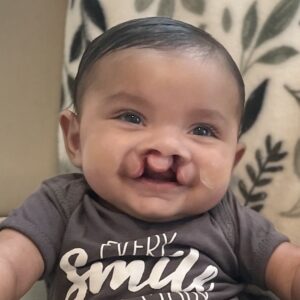
This describes whether the cleft lip is on one side (unilateral) or both sides (bilateral) of the upper lip.
This baby has a unilateral (on one side) cleft lip:
This baby has a bilateral (on both sides) cleft lip:
This describes whether the cleft lip goes up to your baby’s nose (‘complete’) or not.
An incomplete cleft lip:
A complete cleft lip:
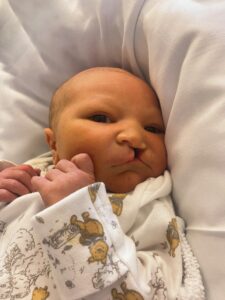
A cleft being ‘syndromic’ means that it happened as part of a ‘Syndrome’, which is when a set of different symptoms all happen together.
There are lots of syndromes linked to cleft, some of which are extremely rare. Your Cleft Team will be on the lookout for the more common syndromes and will let you know if your child needs any extra support or treatment.
‘Asyndromic’ means that a cleft happened on its own and is not part of a syndrome. Most clefts are asyndromic.
A ‘gum notch’ means the cleft goes through part of the gums.
The alveolus is the bone under your gums. If a cleft ‘involves’ the alveolus, this means the cleft goes through this bone.
The ‘palate’ is the roof of the mouth.
The part towards the teeth is called the ‘hard’ palate, and the part towards the back of the throat is called the ‘soft’ palate. You may be able to feel the difference with your tongue.
If your baby has a ‘cleft of the soft palate’, this means the cleft is just in the back part of their palate.
The ‘mucous’ is the lining of the mouth. If a cleft palate is ‘submucous’ it means there is a gap in the muscles in the roof of the mouth, but it’s covered by the lining of the mouth.
This makes a submucous cleft palate more difficult to see and diagnose. However, it can still have a big impact on feeding, speech, hearing and other issues.
If you suspect your child may have a submucous cleft palate which has not been diagnosed, talk to your GP or health visitor.
“I was very keen to breast feed and whilst in hospital and at home, had assistance from several midwives and health visitors, despite our son clearly struggling to feed, I was advised perhaps he just wasn’t a breast fed baby or because I was a first time mum, it may take me a while to grasp!Mum of a baby with an isolated cleft palate
This really affected me, as I felt totally inadequate as a mother, not being able to feed my baby. It was one Sunday, when he was 30 days old, did I have an incredible shock, as I saw inside his mouth and straight up to his nose. The first thing I did, was use my tongue to feel the roof of my mouth to see if I had one too and when I didn’t, I went on to Google to research what this huge hole could be.”
You will be referred to your local NHS Cleft Team. These teams are made up of clinicians who specialise in treating cleft lip and palate.
A Cleft Nurse Specialist will contact you as soon as possible to talk you through what will happen next and assess your baby’s feeding needs. This is often within 24 hours, but may be longer over weekends or public holidays.
Your Cleft Nurse Specialist will be your main point of contact in the first year of your baby’s life; they are usually the best person to go to with any questions or concerns.
There will be a lot of details to keep track of around your baby’s treatment, such as names, contact information and appointment dates, so it’s a good idea to start keeping careful records of these now. These can be helpful as your baby grows up.
After your baby is born and has had their feeding needs assessed by a Cleft Nurse Specialist, you will usually be directed to CLAPA to get special bottles and teats designed for babies born with a cleft.
Each new baby born with a cleft in the UK can get a free Welcome Pack of bottles and teats, and additional feeding equipment can be bought through our website shop.
CLAPA’s regular Antenatal Support Group events welcome both new and expectant parents to help you create a support network, ask questions and share your concerns. You are not alone.
Many parents of children with a cleft have written about their experiences of diagnosis, birth, surgery and beyond. They have shared these personal moments, from the hopeless to the triumphant, to help new and expectant parents prepare for their baby’s future.
Parent Supporters are trained by CLAPA to support others one-on-one, either over the phone or through email. They understand just what you’re going through, as they’ve been through it all themselves!
CLAPA has a private support group on Facebook with over 10,000 UK parents and carers of children born with a cleft.
CLAPA offers a dedicated counselling service for parents and family members (18+) of children born with a cleft.
The Clinical Psychology Team with your Cleft Team can help you to talk through any difficult feelings you might be having. Talk to them about making an appointment.
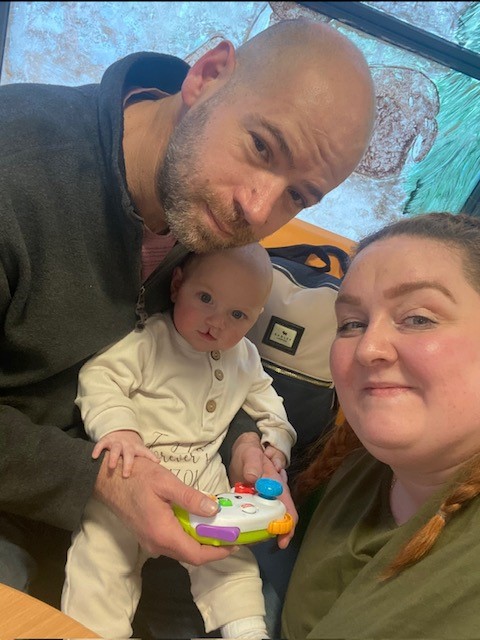
Kate tells her story about Harry’s cleft diagnosis and how CLAPA’s support was so invaluable she became one of our volunteers.

Kevin and Sanjana share their journey from finding out their son Arin would be born with a cleft.

Two Januarys ago, Ben started running – and participated in his first Ironman triathlon last September, raising more than £3,300 for CLAPA.