
What is the CRANE Database?
The Cleft Registry and Audit NEtwork (CRANE) is a national database that collects information about children born with cleft lip and/or palate across the UK.
Information gathered by CRANE has helped improve the care and treatment of children and families affected by a cleft.
If you are interested in statistics on cleft lip and palate in the UK, CRANE’s annual reports are the best place to look.
About the data collected
What kind of information is collected?
CRANE collects information on these children at birth or at diagnosis, and into childhood – including information about the surgical treatments your child has had, and how your child is getting on in terms of their speech, hearing, growth, dental health and overall health.
You can read more about the kind of information collected by CRANE on their website. This information is different depending on whether you live in England and Wales, Northern Ireland, or Scotland.
CRANE needs consent from families for some of the data they collect. Most families say yes to this, as it helps improve cleft care for everyone.
CRANE Information Leaflets and Consent Forms
Why does the database collect information?
The information collected is used to:
- Improve care and treatment by highlighting and sharing best practice
- Reports are produced that let each cleft service know where they are doing well and where they can improve
- Check whether cleft care meets national standards and is consistent for every child, everywhere
- Count the number of babies born with a cleft each year
CRANE report on their findings each year, and as part of this they produce a summary of findings which is aimed at parents and carers. No information is used in the reports that could be used to identify individual children.
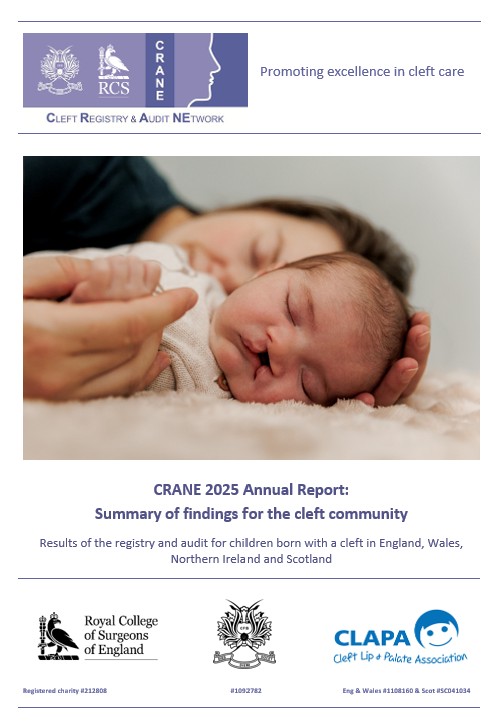
Read the CRANE 2025 Annual Report Summary
Every year, CRANE produces a comprehensive report on what they've learnt through the information collected on their database. This is a summary of these findings aimed at the UK cleft community.